






The Fall Market Is Rewriting the Price Map Across San Diego
Something important is happening beneath the San Diego housing headlines this September.
The market has not suddenly stopped favoring well-positioned homes. In fact, live mid-September data still shows demand running ahead of supply in several North County and coastal communities.
But that advantage is no longer translating into automatic pricing power.
As of September 15, the broader San Diego-Carlsbad-San Marcos single-family market carried a Market Action Index of 42, which Altos Research classifies as a slight seller advantage. Inventory stood near 3,004 homes, the median list price was approximately $1.175 million, and roughly 35% of active listings had already taken a price reduction. The index was 43 a month earlier, indicating a modest cooling in the relationship between demand and available supply.
For anyone watching what their home could command this fall, that combination may matter more than a simple up-or-down price headline.
There are still buyers. There is still leverage in parts of the market. But increasingly, the property has to earn that leverage.
The Market Still Leans Toward Demand, Just Not Everywhere Equally
Carlsbad remains one of the stronger examples.
The city's live September 15 single-family snapshot showed a Market Action Index of 51, with only 84 active homes, a median asking price of approximately $2.15 million, and median market time of 46 days. Altos continues to characterize those conditions as a strong seller's market. But even inside Carlsbad, the picture changes quickly.
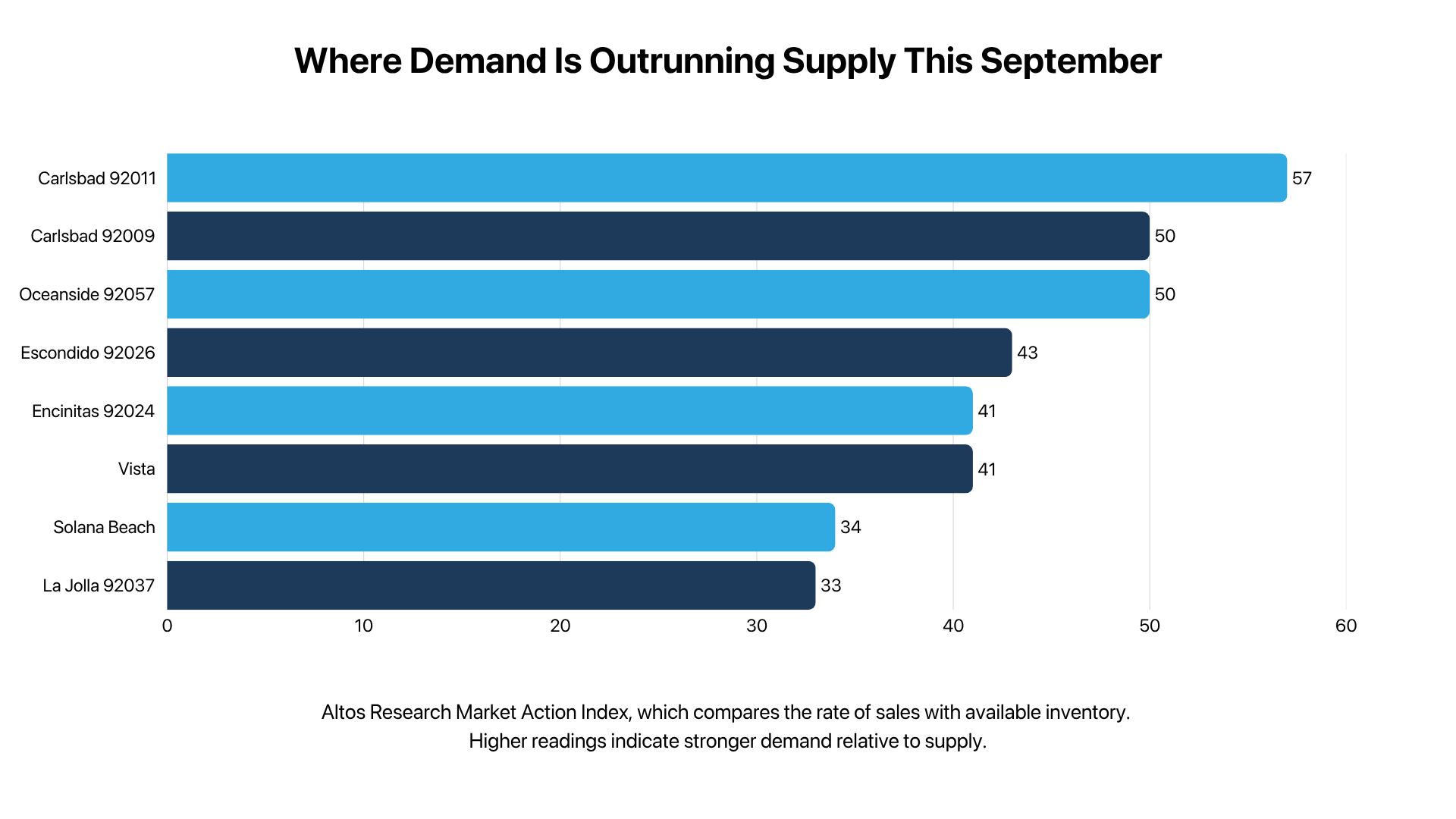
In 92011, the Market Action Index stood at 57, among the strongest readings in the local group, but it was down from 61 a month earlier. Inventory was only 16 homes. In 92009, the index was 50 with 32 active homes, but 38% of active listings had already reduced their asking price.
That is an important distinction. A market can still favor the supply side overall while individual listings struggle if their price, condition or positioning does not match what buyers are willing to accept.
September Is Showing a More Selective Kind of Pricing Power
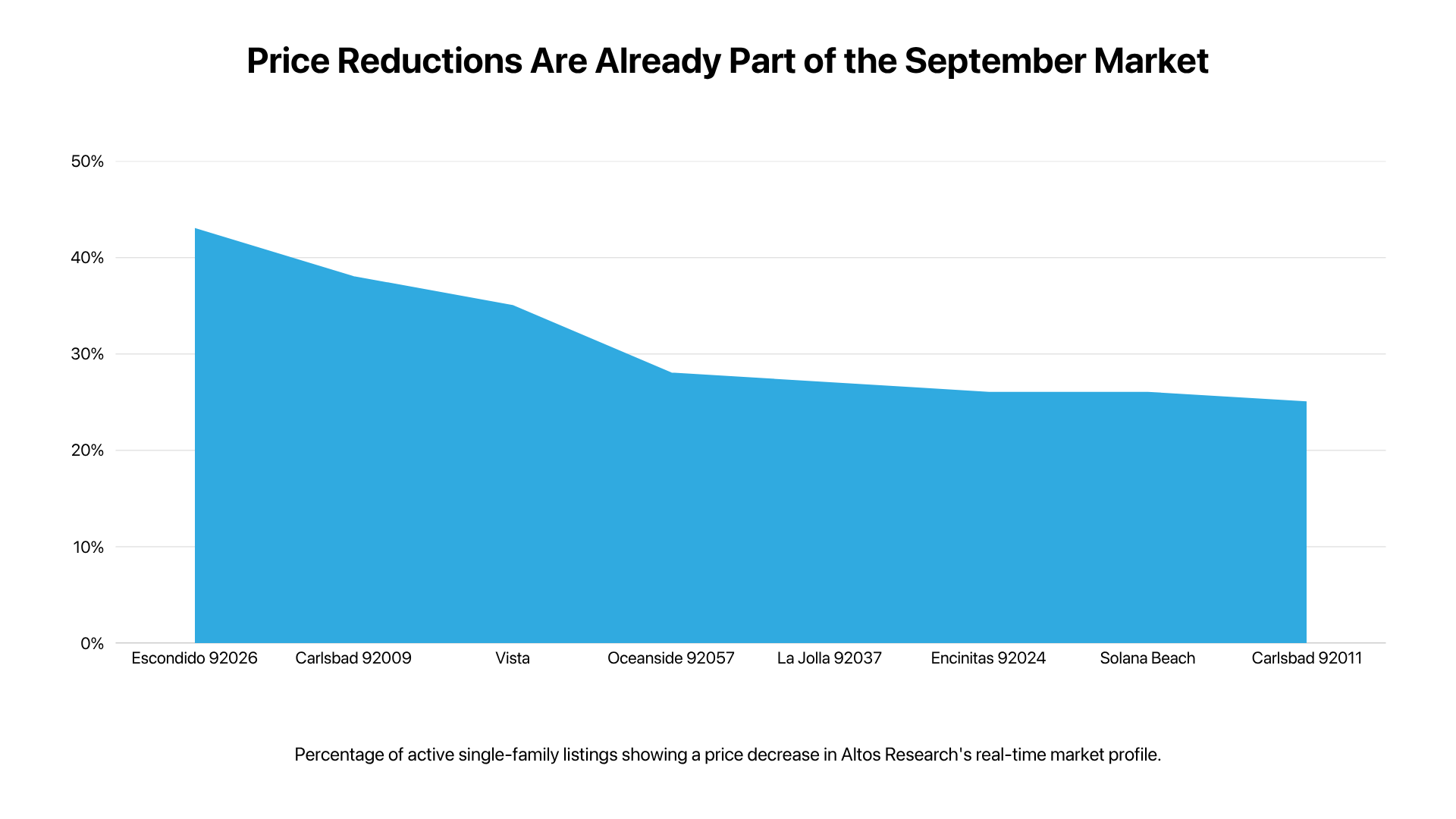
The most revealing number may not be the asking price itself. It may be how many properties have already had to change it. As of September 15, 43% of active single-family listings in Escondido 92026 had experienced a price decrease. That share was 38% in Carlsbad 92009, 35% in Vista, 28% in Oceanside 92057, 27% in La Jolla 92037, and 26% in both Encinitas 92024 and Solana Beach.
Even Carlsbad as a whole, where the Market Action Index remains relatively strong at 51, had price reductions on approximately 31% of active single-family listings.
Those two signals are not contradictory. They show a market where limited supply can preserve leverage while buyers remain selective about value. That makes this fall different from a market where virtually any new listing can be pushed higher simply because inventory is tight.
Carlsbad Shows Why One City Can Produce Completely Different Outcomes
The September closing data makes the point even clearer. On September 14 alone, several sales in Carlsbad 92009 landed on very different sides of their asking prices. One home closed for $2.2 million against a $1.94 million list price, roughly 13% above list. Another closed about 3% above list. Two others recorded the same day closed roughly 3% below their asking prices.
In nearby 92008, a property that closed September 14 sold for $2.146 million against a $1.875 million list price, approximately 14% above list. Yet another 92008 home that closed September 9 sold approximately 8% below its asking price. Those are individual transactions, not ZIP-wide averages.
But that is exactly why they are useful. They demonstrate what a broad median can hide. Even within the same part of Carlsbad during the same September market, one property can generate substantial competition while another requires negotiation below asking.
Encinitas Is Still Favorable, But the Advantage Has Softened
Encinitas 92024 remains on the seller-leaning side of the supply-demand equation, but its live numbers have cooled.
Its Market Action Index stood at 41 on September 15, down from 44 a month earlier. Single-family inventory increased to 72 homes, median market time was 42 days, and approximately 26% of active listings had reduced their price.
Actual September closings reinforce the importance of looking below the citywide number.
Among recent Encinitas sales recorded September 11, one closed approximately 1% above list, another approximately 1% below, and another approximately 2% below. Earlier in the month, a property that had spent considerably longer on the market closed approximately 14% below its latest asking price. The point is not that Encinitas has become weak. It is that being in Encinitas is not, by itself, the pricing strategy.
Oceanside Is Still Moving With Relatively Tight Conditions
Oceanside 92057 carried a Market Action Index of 50 on September 15, placing it firmly in Altos Research's strong seller-market range.
Inventory stood at 76 single-family homes, median days on market were 32, and approximately 28% of active properties had taken a price reduction. The index was slightly lower than the previous month's 51. September closings across Oceanside also show transactions landing close to asking in many cases.
Several homes that closed September 14 sold at their asking prices, while another closed about 1% below. Recent September 11 transactions ranged from approximately 1% above to 3% below list. That is a fairly narrow range compared with some of the larger swings appearing elsewhere, but it still points to buyers making distinctions between individual properties.
Vista Is Showing More Resistance on Price
Vista's September numbers tell a slightly different story. The city had 117 active single-family homes on September 15, a Market Action Index of 41, median market time of 42 days, and price decreases on approximately 35% of active listings. The index had edged down from 42 the previous month.
Some of the September closing results have been equally revealing. A Vista 92081 property closing September 14 sold about 9% below list after 88 days on market. Another September 2 closing in the same ZIP sold approximately 10% below its latest asking price after 85 days, while a separate 92081 property closed September 1 roughly 3% above list after 24 days.
Again, these are individual sales, not averages. But they show the range of outcomes currently possible inside one local market.
Escondido Is the Exception Worth Watching
Escondido 92026 may be one of the most interesting September markets in the group.
Its Market Action Index increased from 40 last month to 43 on September 15, while inventory declined to 63 single-family homes. That indicates the sales-to-inventory relationship has strengthened rather than weakened.
At the same time, 43% of active listings had recorded a price decrease, the highest proportion among the markets included in the graph.
That combination tells a nuanced story.
Demand relative to inventory can strengthen while a significant number of individual properties still need to adjust their asking prices.
Recent September closings reflect that range, too. Some Escondido homes have closed at or slightly above asking, while others finished several percentage points below. For anyone preparing a property for market, that may be one of the clearest reminders that market strength does not eliminate price sensitivity.
Coastal Markets Have Leverage, But Time Matters
Solana Beach and La Jolla remain distinctive because their higher price points and smaller buyer pools can make broad averages particularly sensitive. On September 14, Solana Beach's single-family Market Action Index stood at 34, down from 36 the prior month. Inventory was only 19 homes, yet median market time was 91 days, and 26% of active listings had reduced their price. La Jolla 92037 showed a Market Action Index of 33, down from 34, with 97 active single-family homes, median market time of 84 days, and price reductions on 27% of active listings.
September closings show why those markets cannot be reduced to one number.
On September 11 in La Jolla, one home closed approximately 12% above asking, another roughly 4% above, and another approximately 4% below. Other recent closings landed directly at asking or modestly below.
In Solana Beach, one September 14 sale closed roughly 2% below asking, while a September 10 closing finished essentially at list price. A September 4 property sold about 9% below asking. There is still money moving through these coastal markets. The challenge is assuming every property deserves the same strategy.
The September Message Is Becoming Clearer
The live numbers do not describe a collapsing market. They also do not describe a market where pricing discipline no longer matters. Across most of the local markets examined, the relationship between sales and supply remains favorable enough for Altos Research to classify conditions as either a strong seller's market or a slight seller advantage. At the same time, roughly one-quarter to more than two-fifths of active listings in the selected markets have already taken a price reduction.
That is the tension defining September. A property can enter a market with limited supply and still miss the mark. A home can spend weeks on the market while another nearby property attracts enough interest to close above asking. And two homes in the same ZIP code can produce very different outcomes within days of one another.
This makes the opening position increasingly important. The relevant questions are becoming less about whether "San Diego is up" and more about:
What is competing with this property right now? Where are buyers actually responding? Which recent closings resemble the home closely enough to matter?
How many competing listings have already adjusted their price? And what position gives the property the best chance to capture attention before the market asks for a correction?
Bottom Line
The fall market is rewriting the price map across San Diego, but not because every community is suddenly moving higher or lower.
The more important change is how uneven the market has become.
As of mid-September, demand is still outrunning available supply in many North County and coastal markets. Carlsbad and parts of Oceanside continue to show particularly strong seller-side market action, while Encinitas, Vista, Escondido, Solana Beach and La Jolla remain seller-leaning to varying degrees. Yet price reductions are already common, ranging from roughly one-quarter of active listings in some markets to more than 40% in others.
September's actual closings make the lesson even more local. Homes are selling above asking, at asking and below asking, sometimes within the same ZIP code and on the same day.
For homeowners and buyers across Carlsbad, Encinitas, Oceanside, Vista, San Marcos, Escondido, Cardiff, Solana Beach, Carmel Valley, La Jolla and surrounding North County communities, that makes property-level market knowledge increasingly important.
Shafran Realty Group helps clients interpret that local picture through current competition, recent comparable sales, buyer activity, market time, property condition and pricing strategy.
With Shafran Realty Group currently ranked No. 51 nationwide, No. 20 in California, No. 2 in San Diego, and No. 1 in North San Diego County for 2025, this market perspective is grounded in real local activity, buyer behavior and North County trends.
With more than 39 years of experience in finance and real estate, Alan Shafran brings the perspective needed to understand not simply where the market appears to be heading, but how an individual property fits within the market buyers are responding to today.
Check out this article next