






The Rules That Come With the Keys: What North County Buyers Should Know About HOA Documents Before Closing
You walk through a condo in Carlsbad and love the natural light. A townhome in San Marcos has the extra bedroom you need. A planned community in Oceanside has the pool, green space, and location that fit your lifestyle.
Then comes a very different part of the purchase: the HOA document package.
It is easy to treat those documents as paperwork to get through before closing. But in a California common interest development, the governing documents, financial disclosures, insurance information, assessment notices, and association rules can shape how you use the property long after the keys are handed over. California's Department of Real Estate specifically advises buyers to review these materials carefully because important ownership responsibilities and restrictions may not be visible during a physical inspection.
That matters throughout North County San Diego, where buyers may be considering condominiums, townhomes, and planned communities in Carlsbad, Oceanside, San Marcos, Encinitas, and nearby areas. The right question is not simply, "Does this home have an HOA?" It is, "What exactly am I agreeing to when I buy here?"
What California Requires Sellers to Provide
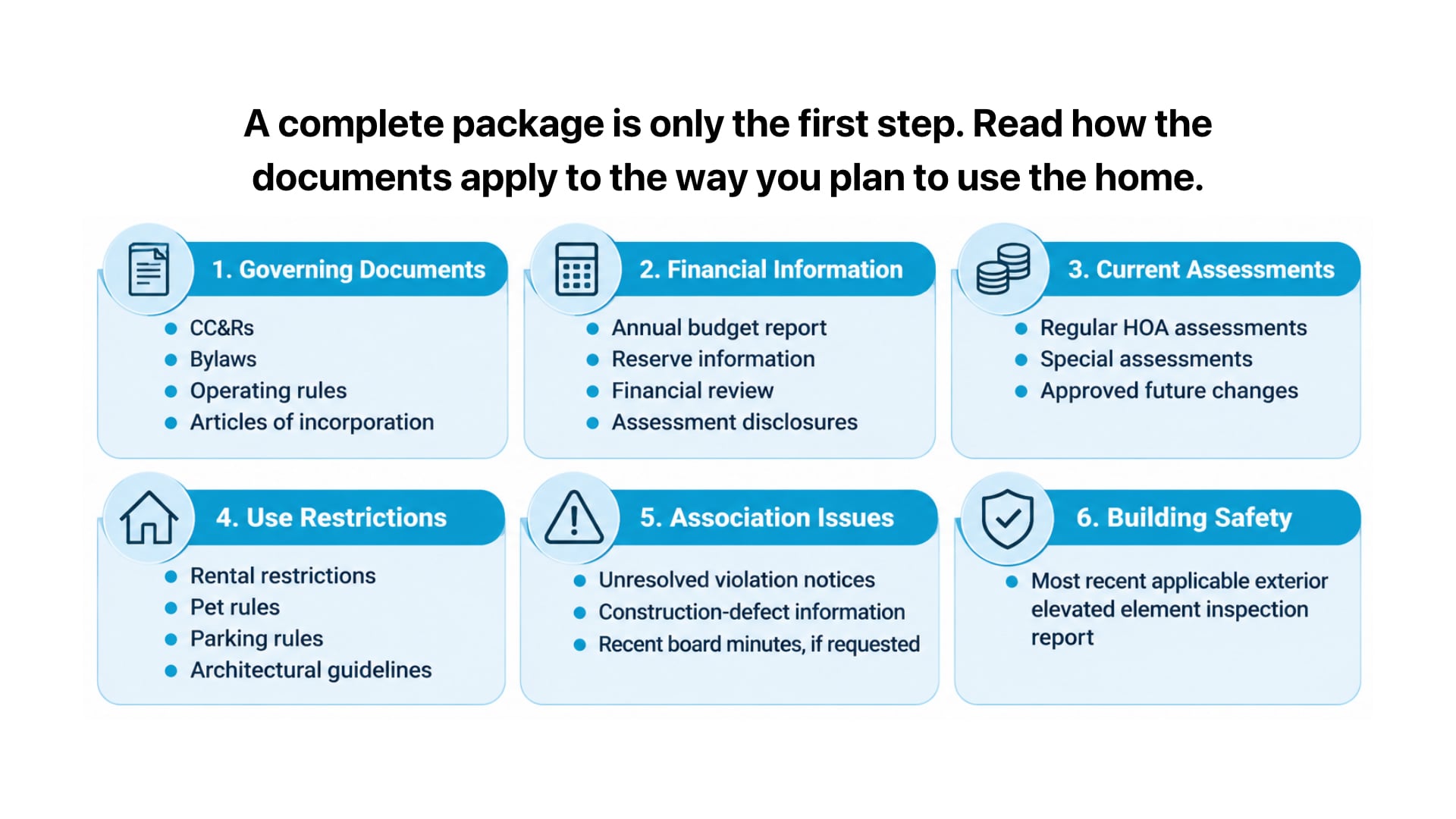
For a resale in a California common interest development, Civil Code Section 4525 requires the seller to provide a prospective purchaser with a specific set of HOA documents and disclosures. The California Department of Real Estate's August 2026 guidance identifies these as including the governing documents, recent annual budget and policy materials, current regular and special assessments, certain unresolved violation notices, construction-defect information when applicable, approved but not-yet-due assessment changes, applicable rental restrictions, and, if requested, approved board meeting minutes from the previous 12 months.
A 2025 law change also expanded the resale disclosure list to include the most recent report from required inspections of exterior elevated elements, such as certain balconies, walkways, and stairways. The Department of Real Estate highlighted that addition in 2026.
The association itself has obligations too. When the owner makes a written request, Civil Code Section 4530 generally requires the association to provide the requested Section 4525 documents within 10 days of mailing or delivery of the request. Electronic delivery must be available when the association maintains the documents electronically.
For buyers, that legal framework provides a useful starting point. It does not mean every important question will be answered automatically. A document package can technically be complete and still require careful reading to understand how the rules apply to your plans for the property. The DRE recommends asking a real estate professional about the practical application of the disclosures and seeking legal or financial advice when a question falls outside an agent's expertise.
Read the Financials for the Story Behind the Amenities
A pool, clubhouse, private road, elevator, gate, roof system, landscaping program, or shared exterior maintenance plan all cost money to operate and maintain. The financial documents help buyers understand how the association plans for those responsibilities.
California law requires an HOA's annual budget report to include an operating budget, a summary of reserves, a reserve funding plan, insurance information, and other financial disclosures. Reserve studies are intended to identify major components the association is responsible for maintaining, estimate their remaining useful life and replacement cost, and establish a plan for funding those future obligations. Civil Code Section 5550 generally requires the underlying reserve study inspection at least once every three years for qualifying associations, with annual review of the study.
A reserve account does not need to be viewed as either "good" or "bad" based on one number alone. A more useful review asks whether the association has identified major upcoming projects, whether the funding plan appears consistent with those obligations, and whether recent board minutes mention repairs, deferred projects, insurance changes, or other expenses that deserve further investigation. The DRE specifically notes that association financial documents may contain important information about future assessment obligations.
Special assessments deserve particular attention. California law generally limits a board from imposing special assessments that, in the aggregate, exceed 5 percent of the association's budgeted gross expenses for the fiscal year without approval of a majority of a quorum of members, subject to statutory exceptions and other provisions. That legal threshold should not be confused with a prediction about whether an assessment will occur. The practical buyer question is whether any assessment is already approved, being discussed, or reasonably connected to major work identified in the documents.
If the board minutes repeatedly discuss a roof replacement, balcony repairs, aging plumbing, litigation, or a large insurance renewal, those details may deserve follow-up even when no new assessment has been formally adopted. The DRE warns that association litigation, for example, can affect reserves and may contribute to a future assessment.
The Rules Can Affect Your
Everyday Life
The most important HOA restriction is often the one that intersects directly with your plans.
If you have a dog, review the pet rules. California law does not allow governing documents to prohibit owners from keeping at least one pet, subject to reasonable association rules, but an HOA may still regulate issues such as conduct, nuisance, common-area use, or other permitted conditions.
If you expect to rent the property in the future, read the rental language carefully rather than relying on a listing description or verbal summary. Section 4525 requires disclosure of certain rental prohibitions contained in the governing documents, and California law places additional limitations on how rental restrictions may apply to owners. The exact effect can depend on the language of the governing documents and when an owner acquired title, which is one reason legal questions should be directed to qualified counsel.
Parking can be equally important. Look for assigned-space rules, guest parking limits, commercial vehicle restrictions, overnight parking requirements, and procedures for adding an electric vehicle charger. California Civil Code Section 4745 prohibits HOA governing documents from effectively prohibiting or unreasonably restricting certain EV charging installations, but installations still may be subject to safety standards, association procedures, insurance requirements, and responsibility for costs.
Future improvements deserve the same attention. If you are already imagining new windows, a patio enclosure, solar equipment, exterior paint, a fence, or other visible changes, review the architectural guidelines before assuming the project will be permitted. California law allows associations to require approval for certain physical changes where the governing documents provide for that process, and associations must give members notice of applicable approval requirements.
The key is to turn the rules into real-life questions: Can your household live comfortably within them? Do they fit how you intend to use the property five years from now, not just on move-in day?
Insurance and Maintenance Boundaries Deserve Their Own Review
One of the most common sources of confusion in a condominium or planned community is the line between what the association maintains and what the individual owner maintains.
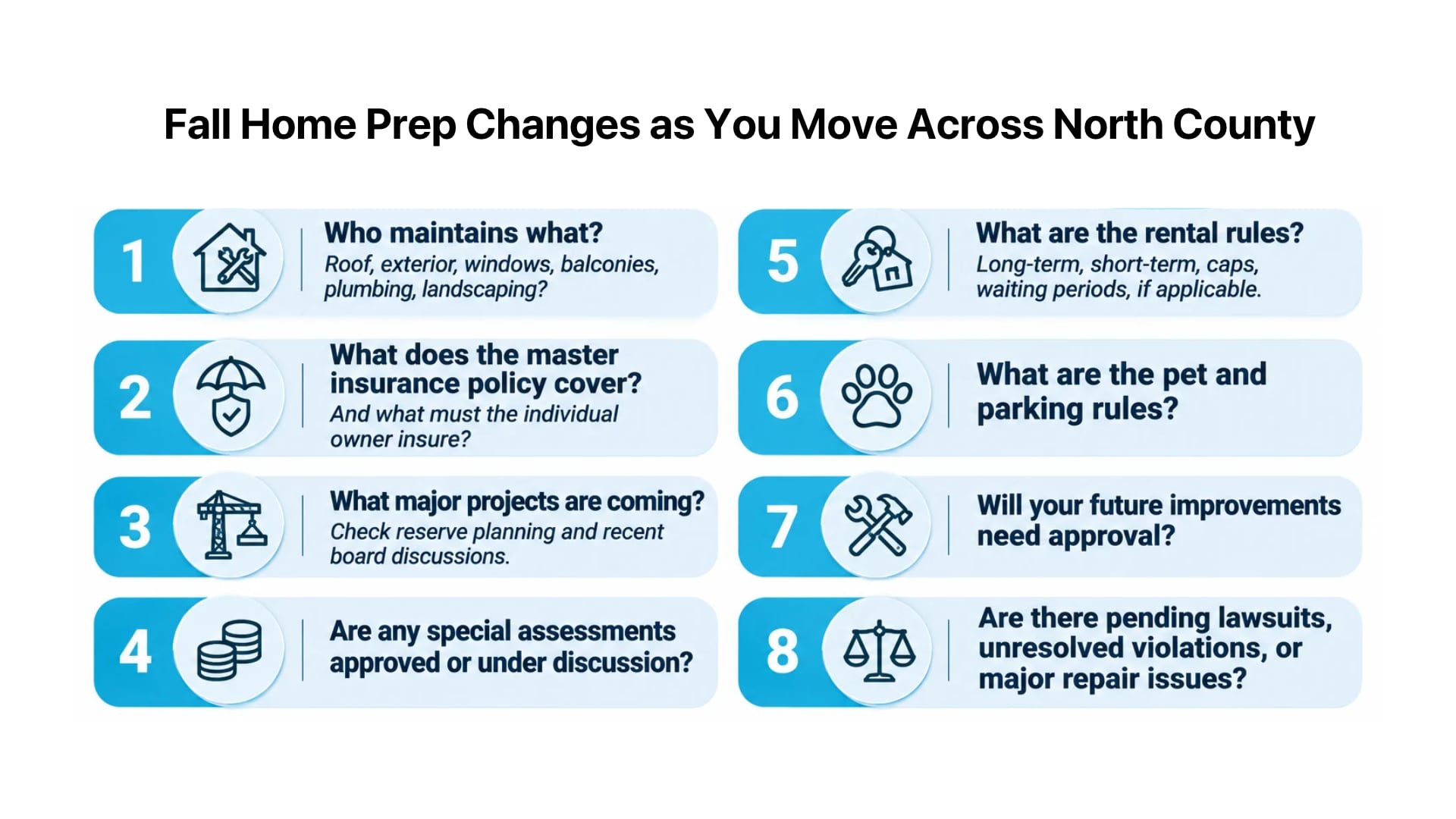
The answer can vary by community. The DRE specifically advises buyers to determine who is responsible for internal and external maintenance and who must insure specific components of a unit.
The California Department of Insurance explains that condominium associations generally purchase insurance for the building structure and common areas, while an individual condo owner's policy typically covers personal property, personal liability, loss of use, and certain interior components or improvements for which the owner is responsible. The Department also notes that buyers should review the association's coverage carefully rather than assuming the master policy protects everything inside the unit.
That makes the master insurance summary a starting point, not the end of the conversation. A buyer may want an insurance professional to review the association's policy alongside the proposed individual policy, especially where there are questions about deductibles, water damage, interior improvements, loss assessment coverage, earthquake risk, or other exclusions.
Maintenance boundaries deserve similar attention. A buyer should be able to answer basic questions such as who repairs a leaking balcony, who replaces windows, who maintains a roof over a townhome, and where responsibility for plumbing or utility lines changes from the association to the individual owner. The governing documents and association policies, rather than assumptions based on the building type, should guide those answers.
How to Review an HOA Package Without Getting Lost in It
An HOA package can be hundreds of pages, but buyers do not have to read it randomly.
Start with the CC&Rs and operating rules to understand restrictions on everyday use. Then review the annual budget, reserve summary, insurance information, and any current or approved assessments. After that, look at recent board minutes for recurring issues, planned projects, litigation, maintenance concerns, or rule changes. If the property has exterior elevated elements covered by California's inspection requirements, read the available inspection report and note any recommendations or repair discussion.
As you review, keep two columns: what the documents clearly say and what still needs an answer.
Questions in the second column might include: Is a major project fully funded? Has a proposed special assessment been formally approved? Does a rental restriction apply to this purchase? Can an EV charger be installed in this particular parking configuration? Does the association or the unit owner insure a specific component?
Those are the questions to bring to the right professional. A real estate agent can help organize the documents, identify practical issues, and ask follow-up questions during the transaction. Legal interpretations should go to an attorney, insurance questions to a licensed insurance professional, and complex financial questions to an appropriate financial or accounting professional. The DRE expressly recommends referring buyers to qualified professionals when an issue moves beyond an agent's expertise.
For buyers considering homes across North County San Diego, this review can also make comparisons more meaningful. Two similar homes may offer very different ownership experiences because their maintenance responsibilities, architectural rules, rental policies, parking arrangements, or association obligations are different.
Bottom Line
Buying a home in a homeowners association community involves more than choosing the right property. HOA rules, financial reserves, insurance coverage, maintenance responsibilities, and potential special assessments can all influence the experience of owning a home long after closing.
For buyers considering condominiums, townhomes, and homes in planned communities across North County San Diego, reviewing these details is an essential part of making an informed decision. Understanding what an association maintains, how it manages its finances, and which restrictions may affect everyday living can help buyers identify potential concerns before committing to a purchase.
Across Carlsbad, Encinitas, Oceanside, San Marcos, Vista, Del Mar, and surrounding communities, every homeowners association operates differently. The opportunity is not simply finding a home that meets your needs today. It is understanding the responsibilities, community expectations, and long-term considerations that come with ownership.
Shafran Realty Group helps buyers navigate these decisions by evaluating property details, reviewing available community information, and identifying the questions that matter before moving forward. With Shafran Realty Group ranked No. 51 nationwide, No. 20 in California, No. 2 in San Diego, and No. 1 in North San Diego County for 2025, this guidance is supported by extensive local market experience and an understanding of the communities buyers are considering.
With more than 39 years of experience in finance and real estate, Alan Shafran brings the perspective needed to help buyers look beyond the property itself and make informed decisions about their next home. Whether purchasing in an established neighborhood or an HOA-managed community, the right guidance can help buyers move forward with greater confidence and a clearer understanding of what ownership truly involves.
Check out this article next